SenegalTourism
From Île de Gorée's slave-trade memorial to the colonial bridge at Saint-Louis, Senegal sits at the westernmost edge of mainland Africa — once the heart of French West Africa, home of mbalax, and one of the continent's most enduring democracies.
A country measured in horizons.
Senegal occupies the westernmost projection of mainland Africa, the Cap-Vert peninsula on which Dakar sits jutting into the Atlantic at the same latitude as the southern Sahara. The Senegal River runs along the northern border with Mauritania, the Casamance River along the southern border with Guinea-Bissau, and the country wraps almost entirely around The Gambia, which traces the Gambia River from the Atlantic inland. The Sahel covers the north — flat, semi-arid scrubland that thickens into Sudanian savanna across the centre — and the Sine-Saloum and Casamance deltas in the south fold into mangroves and palm-lined waterways. Djoudj National Bird Sanctuary at the Senegal River mouth is one of the world's largest migratory bird reserves, UNESCO-listed since 1981; Niokolo-Koba in the southeast holds the country's last lions, antelope, and meaningful forest cover.
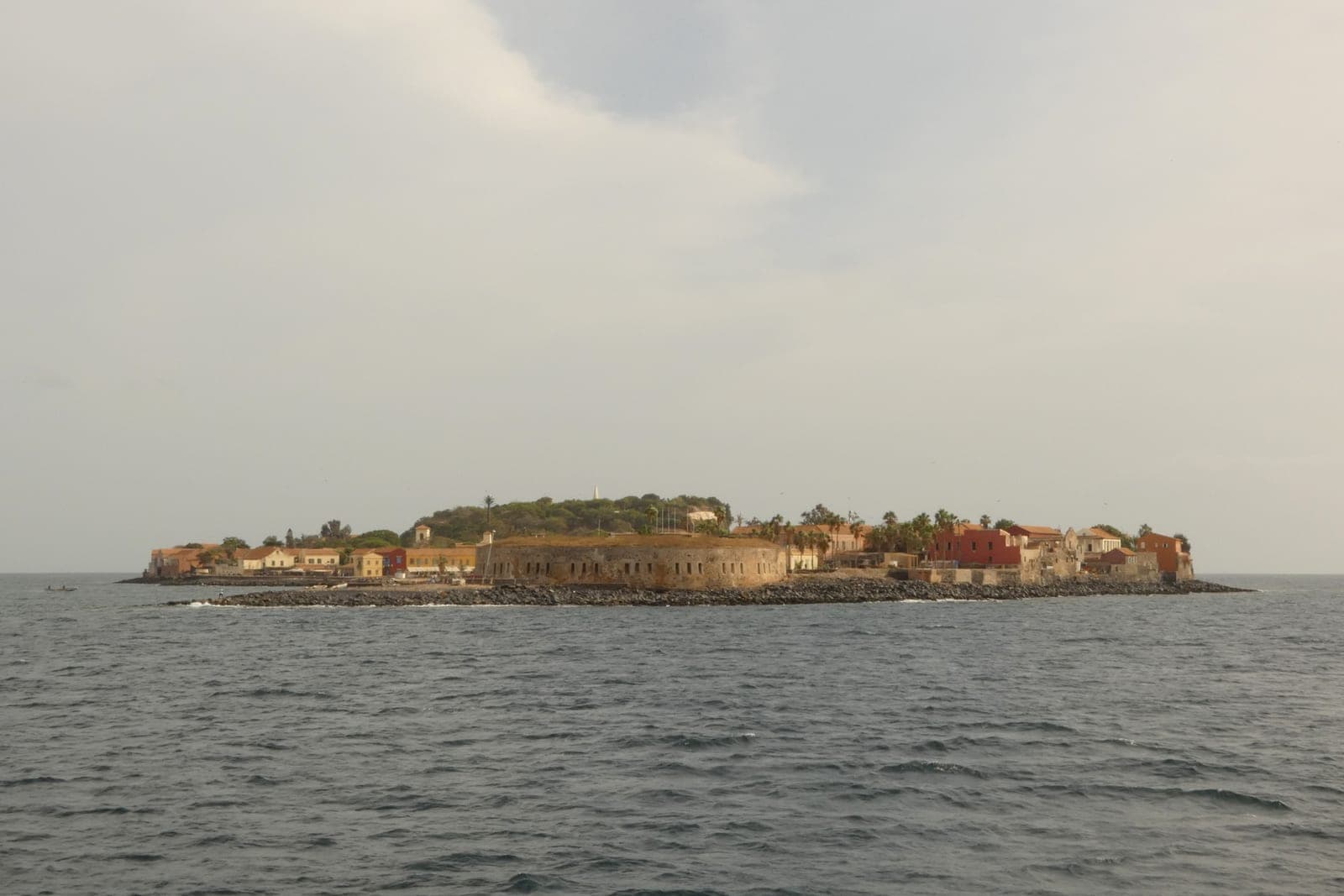
Saint-Louis, founded in 1659 on a sandy island in the Senegal River, was the heart of French colonial West Africa for more than two centuries and briefly served as capital of the colonial federation (1895–1902); its iron bridges and pastel facades still earn it UNESCO listing. Île de Gorée, three kilometres off Dakar, was a slaving post for the Portuguese, Dutch, English, and French in turn; the Maison des Esclaves and its 'door of no return' have been a UNESCO memorial since 1978 and a pilgrimage site for the African diaspora. Senegal became independent in 1960 under poet-president Léopold Sédar Senghor, whose Négritude movement reshaped how the continent wrote about itself, and the country has held competitive elections without a military coup ever since — among the longest such runs in West Africa. The mbalax of Youssou N'Dour and Baaba Maal carries Senegal's voice abroad; inland, the Mouride brotherhood centres on the Great Mosque of Touba, one of the largest in West Africa.
Most travel enters via Dakar's Blaise Diagne International (DSS), about an hour by toll road into the capital. Senegal is visa-free for ninety days for most major nationalities — US, UK, EU, India, ECOWAS — and the standard tourist circuit is short: Gorée by twenty-minute ferry from Dakar, Saint-Louis by road or short flight 270 km north, and the Sine-Saloum or Casamance for a beach-and-river finish. The dry season — November through May — is the strongest window; the harmattan haze settles over the north in December–February, and the southern rains run June–October. The currency is the West African CFA franc (XOF), pegged at 655.957 to the euro, which keeps prices stable and ATMs reliable in Dakar; mobile money (Orange Money, Wave) is widely accepted everywhere else. Wolof is the lingua franca even where French is the official language — a handful of greetings (nanga def, jërëjëf) open most rooms.
Practical info.
Climate
Best time: November–May (dry season; harmattan haze possible Dec–Feb in the north).
Visa & entry
Visa-free for 90 days for US, UK, EU, ECOWAS, India, and 60+ other nationalities. Senegal does not currently operate an eVisa system. Most major nationalities enter visa-free for up to 90 days; stays beyond 90 days require a consular visa applied for in person. Passport validity 6+ months; proof of accommodation and onward travel typically requested. Yellow fever certificate required if arriving from an infected area.
Money
West African CFA franc (XOF). Mobile money is widely accepted; carry some cash for rural travel.
Safety & health
Anti-malarial cover for low-elevation regions; standard travel insurance recommended.
How is Senegal measured?
Tourism is the story; data is the context. Health, population, economy and climate indicators across Senegal — sourced from the World Bank, WHO and UNICEF.
See Senegal in numbers