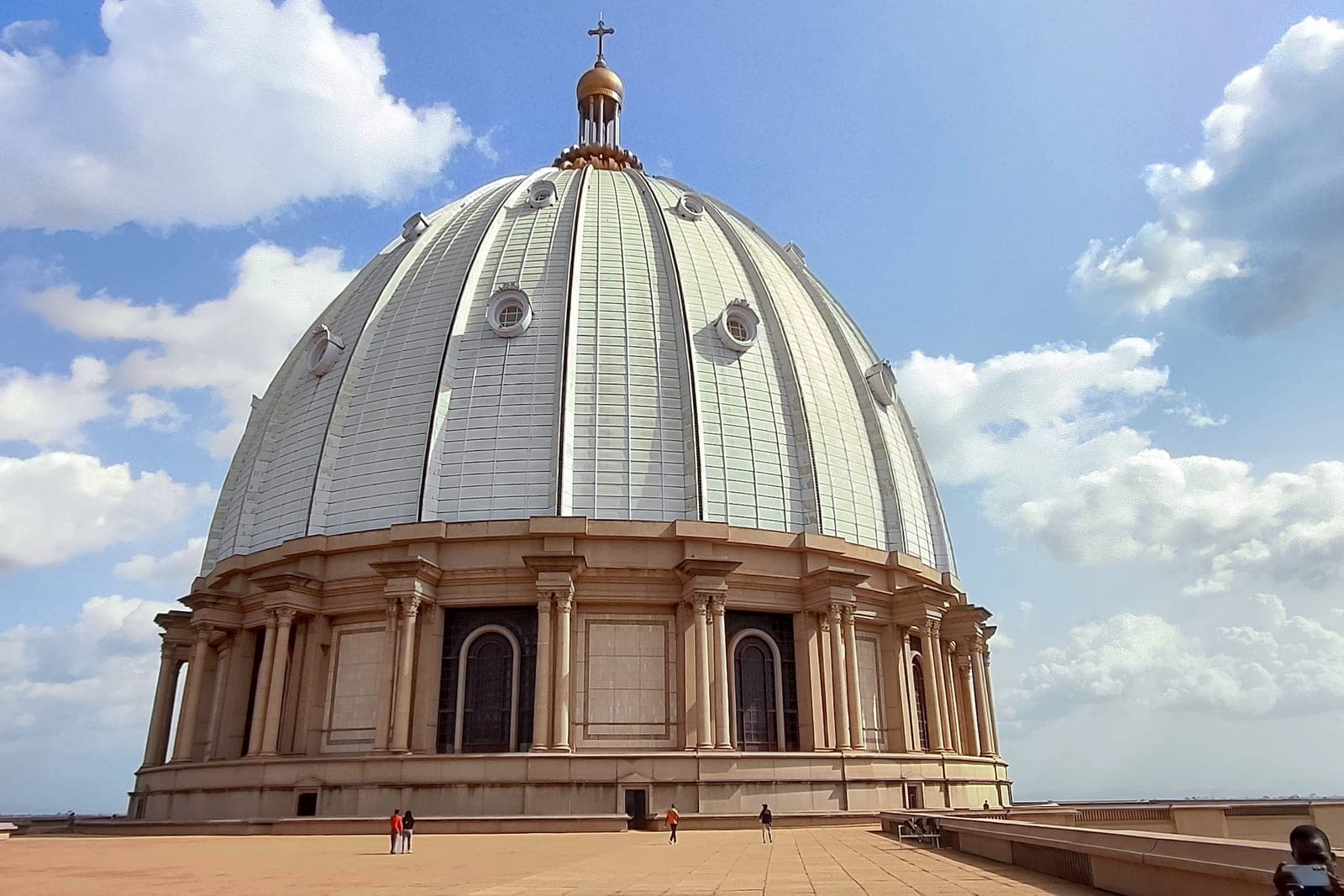
 Photo by Didierwiki, CC0 / public domain, via Wikimedia Commons
Côte d'IvoireTourism
From the basilica dome at Yamoussoukro to the colonial seafront at Grand-Bassam, Côte d'Ivoire is West Africa's largest economy — the world's biggest cocoa producer, a thirty-million-strong republic that runs in French and runs hard.
A country measured in horizons.
Côte d'Ivoire sits on the elbow of West Africa, a country of 322,000 square kilometres that turns from Atlantic lagoons in the south through palm-oil plantations and tropical forest into the dryer Sudanian savanna of the north. The Comoé River runs through Comoé National Park (UNESCO since 1983), one of the largest protected savanna areas in West Africa; Taï National Park to the southwest is the last major block of primary Upper Guinean rainforest, home to pygmy hippos, chimpanzees, and the country's largest forest elephants. Mount Nimba on the western border with Guinea and Liberia is the country's highest point at 1,752 metres, with strict-reserve status as a UNESCO site. The coast is fringed by 80 kilometres of lagoons — Ébrié, Aby, Tagba — that form natural ports and, around Abidjan, the urban skeleton of the country.
Côte d'Ivoire was a French colony from 1893 and independent under Félix Houphouët-Boigny from 1960 — the country's first president, who ruled for thirty-three years and built the entire administrative capital at Yamoussoukro around his home village. His Basilica of Our Lady of Peace, completed in 1989, is the largest Christian church in the world by floor area and an architectural homage to St Peter's in Rome. The country's modern history is shaped by cocoa: Côte d'Ivoire grows more than forty per cent of the world's supply, and the crop has driven both economic strength and political tension, including the 2002–2007 civil war that split the country in two and the 2010–2011 post-electoral crisis between Laurent Gbagbo and Alassane Ouattara. Stability under Ouattara since 2011 has brought one of West Africa's fastest growth rates back; Grand-Bassam's restored colonial centre was UNESCO-listed in 2012.
Most travel enters via Félix Houphouët-Boigny International Airport (ABJ) at Abidjan — the regional aviation hub for West Africa. An eVisa is required for most nationalities outside ECOWAS: apply at snedai.com, the fee is EUR 73 for up to ninety days (single or multi-entry, multi-entry standard), and processing runs three to ten business days. ECOWAS citizens (Nigeria, Ghana, Senegal, Mali and others) enter visa-free for ninety days. The dry season runs November through March — the harmattan settles haze across the north in December and January — and the rainy season runs April through July, with a shorter second rains in October. Currency is the West African CFA franc (XOF), pegged at 655.957 to the euro and shared across the eight-country UEMOA monetary union. French is the unavoidable working language; Dyula is the country's commercial lingua franca and useful in any market.
Practical info.
Climate
Best time: November–March (dry season; harmattan haze possible Dec–Jan in the north).
Visa & entry
eVisa required for most nationalities outside ECOWAS; ECOWAS citizens enter visa-free for 90 days. Apply at snedai.com (SNEDAI eVisa system). Fee EUR 73 for up to 90 days (multi-entry standard); processing 3–10 business days. ECOWAS citizens visa-free for 90 days. Passport valid 6+ months with at least one blank page. Yellow fever certificate required.
Money
West African CFA franc (XOF). Mobile money is widely accepted; carry some cash for rural travel.
Safety & health
Anti-malarial cover for low-elevation regions; standard travel insurance recommended.
How is Côte d'Ivoire measured?
Tourism is the story; data is the context. Health, population, economy and climate indicators across Côte d'Ivoire — sourced from the World Bank, WHO and UNICEF.
See Côte d'Ivoire in numbers