MozambiqueTourism
From the dunes of the Bazaruto Archipelago to the dhows of Mozambique Island, Mozambique runs more than 2,400 kilometres of Indian Ocean coastline — Portugal's last great African colony, home to coral reefs and the restored wildlife of Gorongosa.
A country measured in horizons.
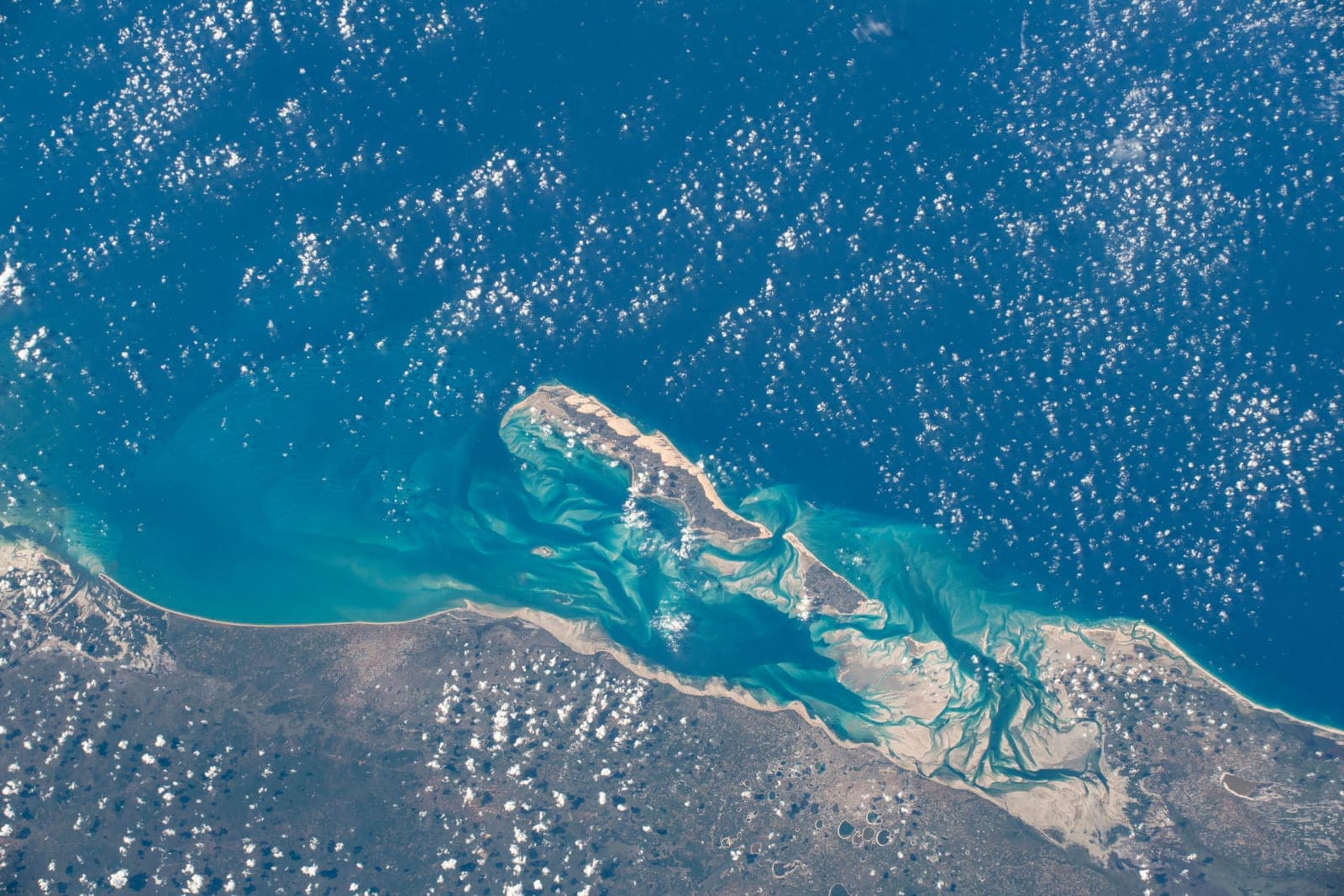
Mozambique stretches more than 2,400 kilometres along the Indian Ocean — one of the longest coastlines on the African continent — and the country's life turns toward the sea. The Zambezi River cuts the country in half on its way from the Zambian highlands to the Mozambique Channel, dividing the lush, mountainous north from the savanna-and-coast belt of the south. The Bazaruto Archipelago in Inhambane province holds five coral-fringed islands and some of the tallest coastal sand dunes in the Indian Ocean; the Quirimbas Archipelago further north — thirty-two islands stretched along the Cabo Delgado coast — was Portugal's first stronghold on the East African trade route. Inland, the country runs into Lake Niassa (Lake Malawi), Africa's third-largest lake, along its northwest border, and Gorongosa National Park sits at the southern end of the Great Rift Valley.
Mozambique came under Portuguese control from 1498 and held it for nearly five centuries, making the stone town of Mozambique Island (UNESCO since 1991), Maputo's iron-framed central railway station, and the medieval coral-rag mosques of Ibo among the most complete Portuguese colonial fabric anywhere on the continent. The lusophone overlay still shapes the country: the official language remains Portuguese, marrabenta is the national dance music, and the kitchen runs on piri-piri and Indian Ocean prawns. Independence came in 1975 under FRELIMO and Samora Machel, immediately followed by a fifteen-year civil war (1977–1992) against RENAMO that left close to a million dead and the economy in ruins. Recovery has been substantial but uneven: Gorongosa National Park, gutted in the war, has become one of the continent's great conservation comeback stories, while a separate Islamist insurgency in Cabo Delgado province has displaced more than a million people since 2017 and continues through 2026.
From 11 February 2026, Mozambique requires an Electronic Travel Authorisation (ETA) before arrival for most foreign travellers — including many nationalities that were previously visa-free. Apply at evisa.gov.mz at least 48 hours before departure; the ETA covers stays of up to thirty days. SADC nationals (South Africa, Zimbabwe, Tanzania, Zambia and others) still walk in visa-free for thirty days. Maputo International (MPM) is the principal hub, with Vilanculos (VNX) handling charters into Bazaruto and Pemba (POL) servicing the Quirimbas. The dry season runs May through October — best for diving Bazaruto reefs and for game viewing at Gorongosa; the wet season (November–April) is humid and vivid green, with cyclone risk peaking February–March. Three travel advisories matter for itinerary planning: US Level 4 (Do Not Travel) for Cabo Delgado province, the Niassa Special Reserve, and parts of northern Nampula due to the ongoing insurgency; Level 2 (Exercise Increased Caution) elsewhere. The southern coast — Inhambane, Vilanculos, Tofo, Bazaruto, Maputo — is the active tourism circuit.
Practical info.
Climate
Best time: May–October (dry season; diving and game viewing peak); cyclone risk February–March in the wet months.
Visa & entry
ETA required for most foreign travellers since 11 February 2026; SADC nationals enter visa-free for 30 days. Mozambique launched a mandatory ETA on 11 February 2026 — apply at evisa.gov.mz at least 48 hours before arrival, even for previously visa-free nationalities. ETA covers stays up to 30 days. SADC nationals (South Africa, Zimbabwe, Tanzania, Zambia, etc.) still enter visa-free for 30 days. US Level 4 (Do Not Travel) for Cabo Delgado, Niassa Special Reserve, and parts of northern Nampula due to ongoing insurgency since 2017.
Money
Mozambican metical (MZN). Mobile money is widely accepted; carry some cash for rural travel.
Safety & health
Anti-malarial cover for low-elevation regions; standard travel insurance recommended.
How is Mozambique measured?
Tourism is the story; data is the context. Health, population, economy and climate indicators across Mozambique — sourced from the World Bank, WHO and UNICEF.
See Mozambique in numbers