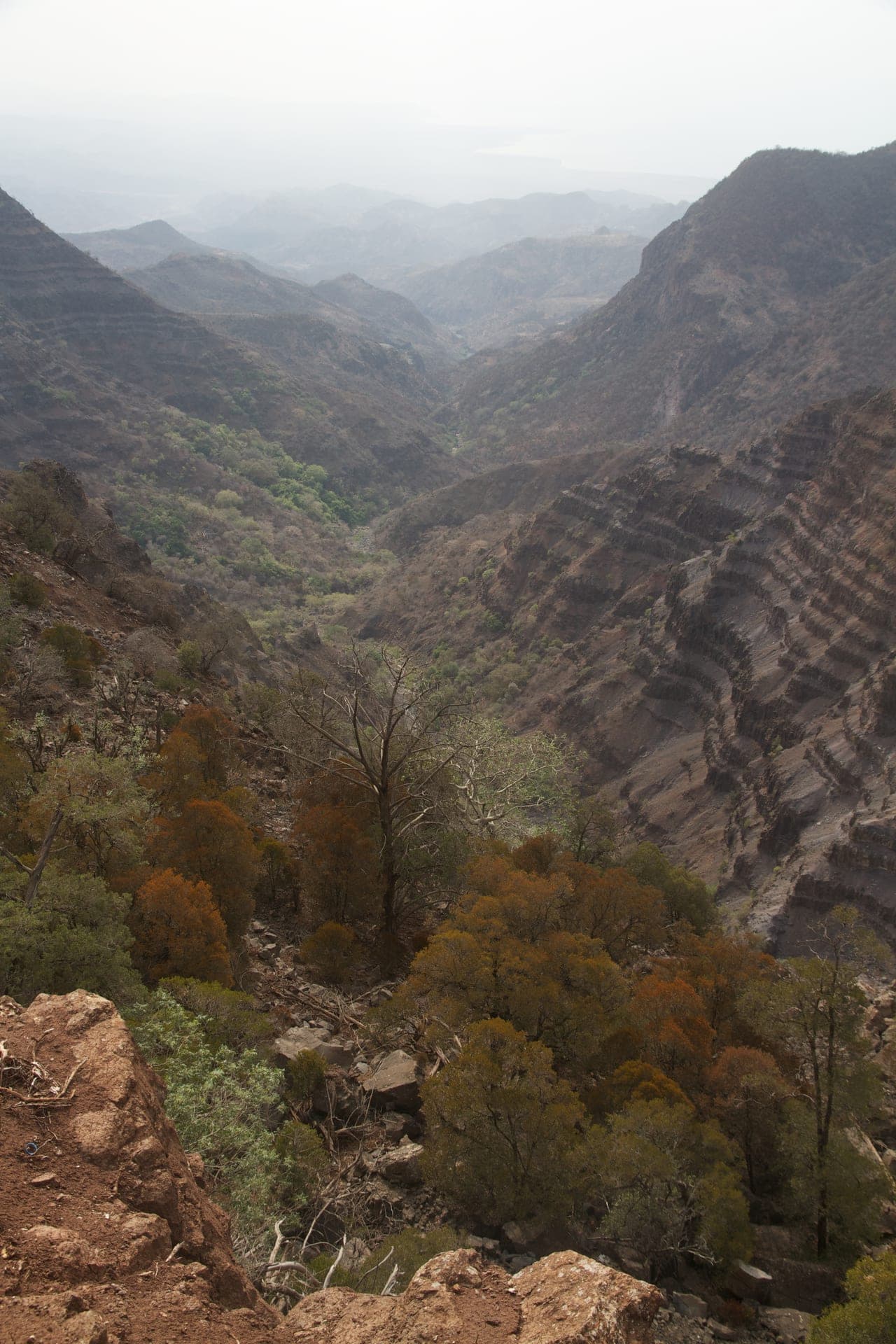
Photo by Mheidegger (Lac Assal salt flats), CC BY 4.0, via Wikimedia Commons
DjiboutiTourism
The most stable and visitable country in this batch by a wide margin, tiny Djibouti packs Africa's lowest and most hypersaline point, an active volcano, whale sharks in the Gulf of Tadjoura, and a strategic position at the mouth of the Red Sea that has drawn US, French, Chinese and Japanese military bases into a country smaller than New Jersey.
A country measured in horizons.
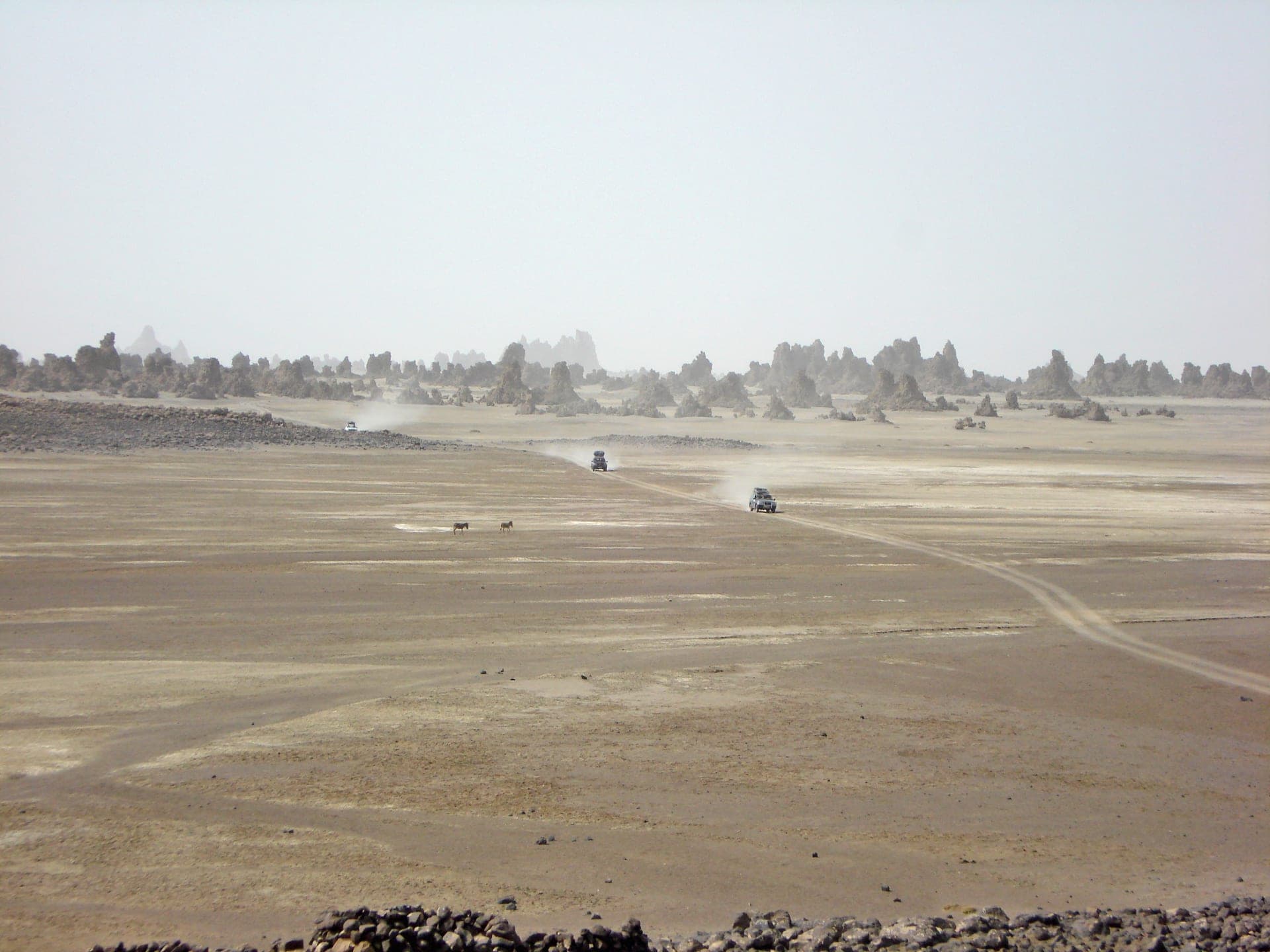
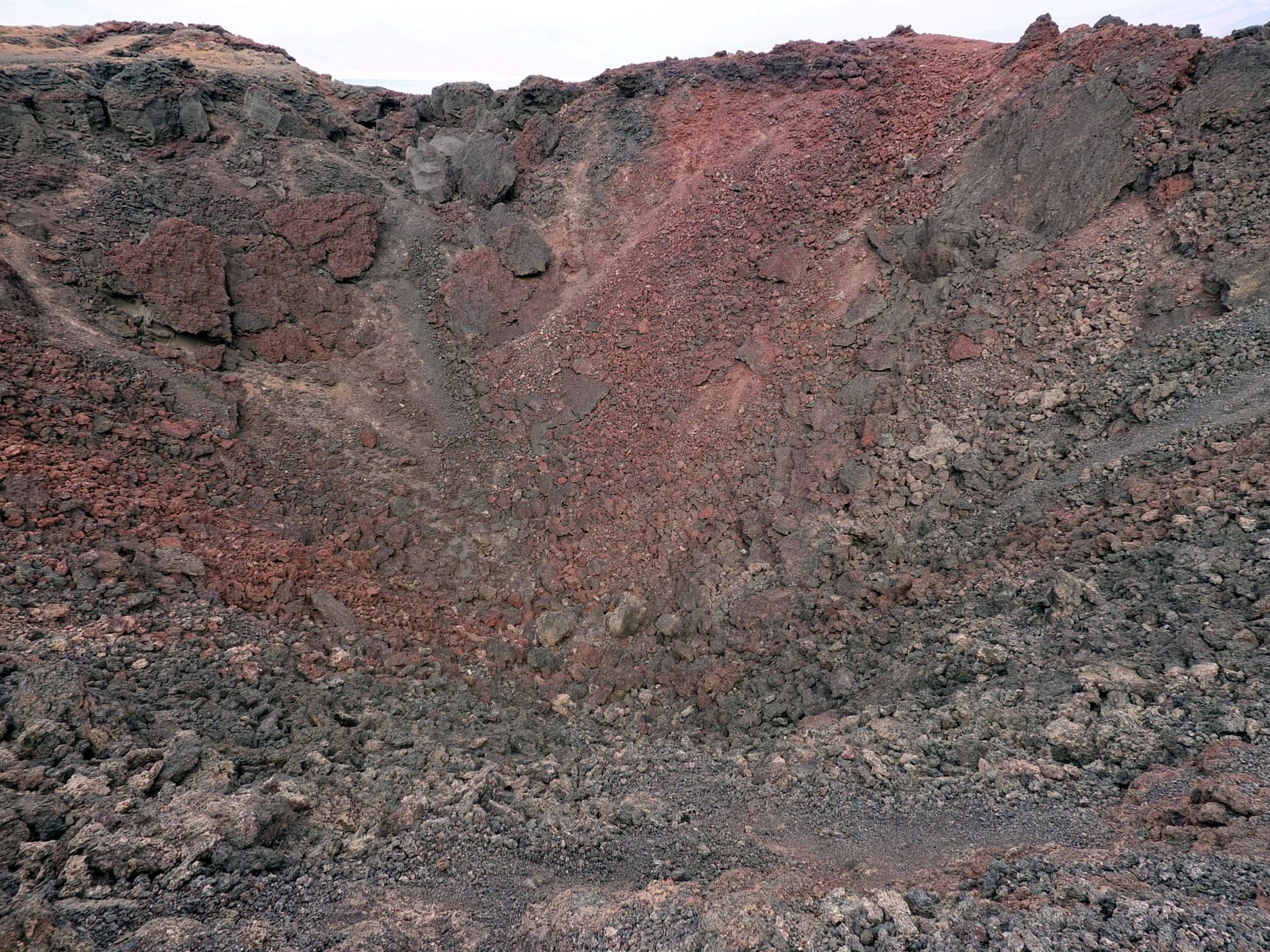
Djibouti's defining landscape sits along the Assal–Ghoubbat al Kharab rift, part of the East African Rift within the Afar Triangle. Lac Assal, roughly 120 kilometres west of Djibouti City, lies 155 metres below sea level — the lowest point in Africa and the third-lowest on Earth after the Dead Sea and Israel's Sea of Galilee — and its surface salinity of around 276 grams per litre (reaching nearly 400 g/L at depth) makes it one of the most hypersaline bodies of water anywhere, roughly ten times saltier than the ocean; Djibouti has proposed the wider Lac Assal zone for UNESCO World Heritage status. Nearby, Lake Abbé is famous for limestone chimney formations up to 45 metres tall, built up after underground thermal springs were exposed when the Awash River was diverted for irrigation in the 1950s — a genuinely striking, otherworldly landscape, though the popular claim that the original Planet of the Apes was filmed here is false; that 1968 film was shot entirely in Arizona and California, and the Lake Abbé connection is a myth repeated in guidebooks and tour marketing rather than a documented fact. The Ardoukoba volcano, between Lac Assal and the inlet of Ghoubet-Kharab, last erupted in November 1978 after roughly 3,000 years of dormancy, producing lava fountaining and a new 100-metre cone; Ghoubet-Kharab itself — nicknamed 'the devil's throat' — and the nearby Seven Brothers islets rank among the Gulf of Tadjoura's best dive sites, with over 200 recorded coral species, grey reef sharks and, from roughly October to February, migrating whale sharks. In the Tadjoura region's Makarassou Massif, the Abourma rock art site holds nearly three kilometres of Neolithic petroglyphs — giraffes, ostriches, antelope — among the most extensive rock art collections in East Africa; it was declared a Djiboutian national monument in January 2026, and the country filed its first-ever formal UNESCO World Heritage nomination for the site the same year.
Djibouti's politics have been dominated by one figure since independence from France in 1977: President Ismaïl Omar Guelleh, in power since 1999, won a sixth consecutive term on 10 April 2026 with a reported 97.81% of the vote in an election largely boycotted by opposition parties over irregularities, and was sworn in on 9 May 2026; he abolished presidential term limits in 2010. What sets Djibouti apart geopolitically is its position at the mouth of the Red Sea on the Bab el-Mandeb Strait, one of the world's busiest shipping chokepoints, which has made the country host to a remarkable concentration of foreign military bases — reportedly eight to eleven in total, including France's roughly 1,500-troop Base Aérienne 188, the US's Camp Lemonnier (home to US Africa Command's only permanent base on the continent, with more than 4,000 personnel), China's first-ever overseas military base (opened 2017), and Japan's first overseas base since World War II (opened 2011). The US State Department rates Djibouti Level 2 — Exercise Increased Caution overall, citing terrorism risk, with a stricter Level 3 — Reconsider Travel applying within about 10 miles of the Eritrea border in the Tadjoura and Obock regions, reflecting Djiboutian government access restrictions there rather than any specific incident.
Djibouti's visa situation carries one genuine wrinkle worth flagging: while several vendor sites still advertise an active eVisa system (around USD 23 for a 90-day tourist visa), other sources — including guidance attributed to the US State Department — indicate the eVisa system was effectively discontinued in 2025, with the application website still online but not reliably processing applications. The safer, current framing is that visitors should plan on either visa-on-arrival at Djibouti–Ambouli International Airport for air arrivals (also around USD 23) or an advance visa from a Djiboutian embassy or consulate, which remains required for land or sea entry; anyone relying on the eVisa route should verify its status directly before travel rather than assume it's functioning. Djibouti is one of the hottest countries on Earth, with a hot season running roughly May to September (highs regularly reaching 45°C and high humidity, July the hottest month) and a markedly more comfortable cool season from mid-October to April, averaging around 25°C; December through February, the coolest window, is the best time to visit, and also lines up with the Gulf of Tadjoura's whale shark season, which peaks around December and January when calmer seas and better visibility draw juvenile whale sharks near Ras Korali.
Practical info.
Climate
Best time: Dec–Feb (coolest, driest window); also peak whale-shark season in the Gulf of Tadjoura.
Visa & entry
Visa on arrival (~USD 23) or advance embassy visa; eVisa system reportedly discontinued in 2025. Visa on arrival is available at Djibouti-Ambouli International Airport for around USD 23; an advance visa from a Djiboutian embassy or consulate is required for land or sea entry. Several vendor sites still advertise an eVisa system, but other sources indicate it was effectively discontinued in 2025 even though the application website remains online — verify its status directly before relying on it. The US State Department rates Djibouti Level 2 — Exercise Increased Caution overall, with Level 3 within about 10 miles of the Eritrea border.
Money
Djiboutian franc (DJF). Mobile money is widely accepted; carry some cash for rural travel.
Safety & health
Anti-malarial cover for low-elevation regions; standard travel insurance recommended.
How is Djibouti measured?
Tourism is the story; data is the context. Health, population, economy and climate indicators across Djibouti — sourced from the World Bank, WHO and UNICEF.
See Djibouti in numbers