CameroonTourism
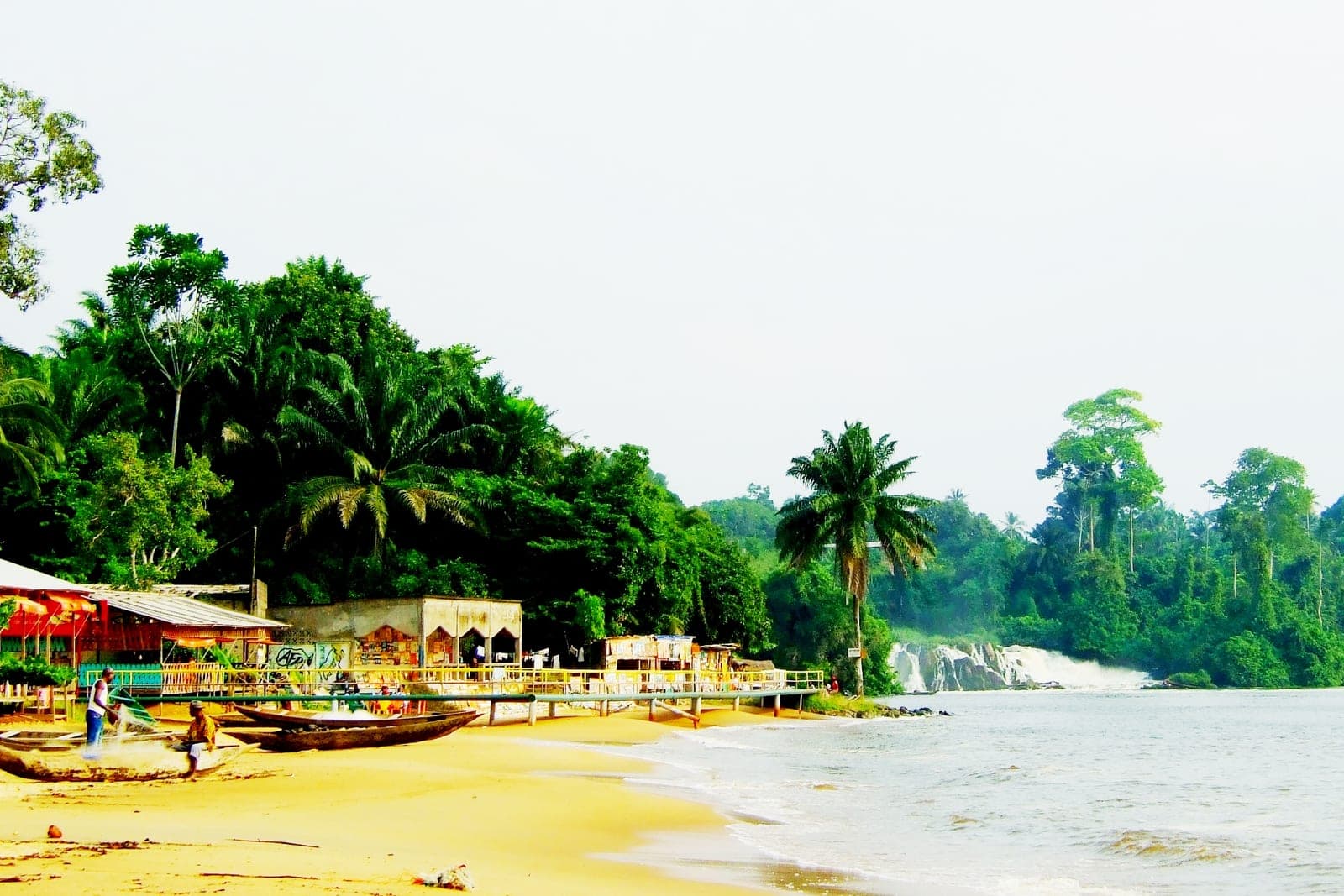
From the Lobé Falls dropping straight into the Atlantic at Kribi to Mount Cameroon's volcano above the Bight of Biafra, Cameroon is often called 'Africa in miniature' — beach, rainforest, savanna, and Sahel inside a single country.
A country measured in horizons.
Cameroon hinges on the Gulf of Guinea and runs north into the Sahel, packing more ecological variety than any other country in West or Central Africa — the reason guidebooks call it 'Africa in miniature.' Mount Cameroon (4,040 metres) is West Africa's highest peak and an active volcano, rising straight out of the sea at Limbé; the Lobé Falls south of Kribi drop directly into the Atlantic, one of only a handful of waterfalls in the world that do so. Inland, the Dja Faunal Reserve (UNESCO since 1987) holds one of the largest tracts of intact Congo Basin rainforest, home to forest elephants, western lowland gorillas, mandrills, and chimpanzees. The far north shifts entirely: the Mandara Mountains and the savanna of Waza National Park stretch toward Lake Chad, and the Sahel feeds into the Sudanian zone of Adamawa. Climate runs from equatorial in the south to semi-arid in the north — Yaoundé sits in a 4°N transition belt, Maroua in a 10°N dry one.
Cameroon is one of the more linguistically complex states on the continent — German Kamerun from 1884 until World War I, then partitioned between France (the larger eastern portion) and Britain (the smaller Southern Cameroons), and reunified at independence in 1960–61. The result is the only officially bilingual country in Africa where French and English are both official languages, alongside roughly 250 indigenous languages. Paul Biya, in power since 1982, is the longest-serving head of state in Africa; the bilingual constitutional compromise has frayed badly since 2017, with the Anglophone Crisis in the Northwest and Southwest regions producing an ongoing separatist conflict, periodic communication blackouts, and more than 6,000 reported deaths. The country also faces Boko Haram and ISIS-West Africa incursions in the Far North. Cultural depth survives all of it: Foumban's royal palace and the Bamoun script of King Njoya, the lamidates of the north, the Bantu kingdoms of the highlands, and the wider Makossa and Bikutsi music traditions that gave the continent Manu Dibango.
Most international travel enters via Douala International Airport (DLA) or Yaoundé Nsimalen (NSI). Cameroon launched a fully online eVisa at evisacam.cm in 2023, and most foreign visitors must apply (CEMAC citizens of Central African states are exempt); the tourist eVisa runs around USD 100 for a 30-day stay, requires a yellow fever certificate and proof of onward travel, and is the only legal pre-arrival route. The dry season runs November through February in the south and is the strongest window for trekking Mount Cameroon and visiting Kribi; the rainy season runs June through October. Travel advisories matter. The US currently posts Level 4 (Do Not Travel) for the Northwest, Southwest, and Far North regions, plus the 20-kilometre border strips with the Central African Republic, Chad, and Nigeria, due to the Anglophone Crisis and Boko Haram activity. The accessible tourism circuit is the centre and south — Yaoundé, the Kribi coast, Dja Reserve, and the West Region around Foumban and Bafoussam.
Practical info.
Climate
Best time: November–February (southern dry season; Mt Cameroon trekking, Kribi coast); June–October is rainy.
Visa & entry
eVisa required for most nationalities via evisacam.cm; CEMAC citizens visa-free. Cameroon shifted to a fully online eVisa at evisacam.cm in 2023. Tourist eVisa is approx USD 100 for a 30-day stay; passport valid 6+ months, yellow fever certificate required. CEMAC nationals (Central African states) enter visa-free. US Level 4 (Do Not Travel) for Northwest, Southwest, and Far North regions, plus 20 km border zones with CAR/Chad/Nigeria due to ongoing Anglophone crisis and Boko Haram activity.
Money
Central African CFA franc (XAF). Mobile money is widely accepted; carry some cash for rural travel.
Safety & health
Anti-malarial cover for low-elevation regions; standard travel insurance recommended.
How is Cameroon measured?
Tourism is the story; data is the context. Health, population, economy and climate indicators across Cameroon — sourced from the World Bank, WHO and UNICEF.
See Cameroon in numbers