TunisiaTourism
From the Phoenician harbours of Carthage to the Roman amphitheatre at El Jem, Tunisia is Africa's northernmost country — Mediterranean to its core, the cradle of Hannibal's Carthage and the birthplace of the 2010 Arab Spring.
A country measured in horizons.
Tunisia is Africa's smallest North African country and its northernmost mainland edge — Cap Angela at Bizerte juts further north than Tangier or Algiers, and only 140 kilometres of the Strait of Sicily separates Cap Bon from Italy. The Tell Atlas throws forested ridges down to a Mediterranean coastline of more than 1,100 kilometres; the central plateau dries into salt lakes (the Chotts), and the southern third opens onto the Sahara proper — the dunes of the Grand Erg Oriental around Douz, the Berber troglodyte villages of Matmata (where Star Wars filmed Tatooine), the date-palm oases of Tozeur and Chebika. Djerba island in the southeast holds North Africa's oldest continuously inhabited Jewish community at the El Ghriba synagogue. The climate runs Mediterranean on the coast and arid in the south — about the closest a single country comes to packing Europe and the Sahara into one drive.
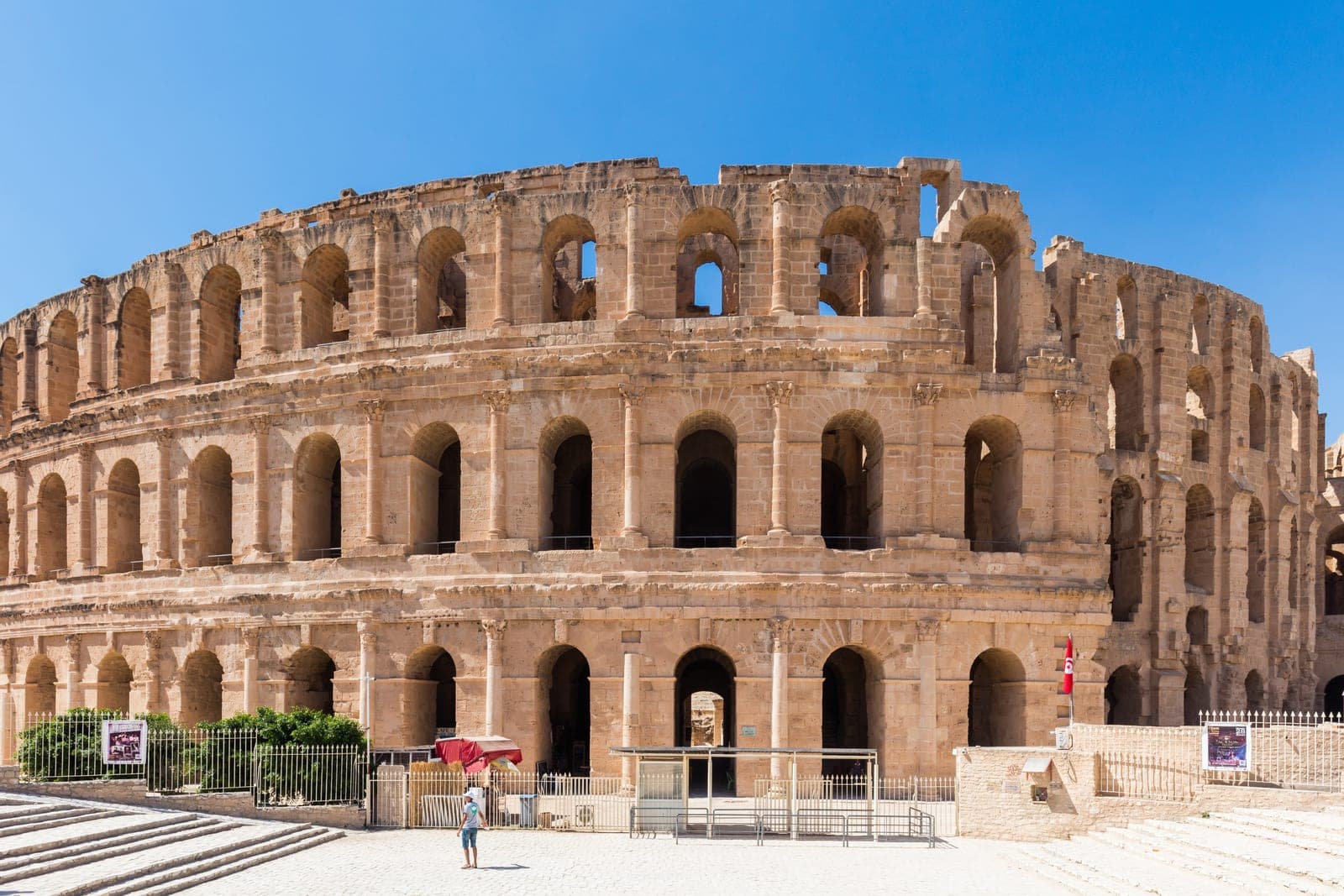
Few countries hold this much history per square kilometre. Phoenician traders founded Carthage in 814 BCE on the bay where Tunis now sits; Hannibal crossed the Alps from here in 218 BCE; Rome razed the city in 146 BCE and rebuilt it as the capital of Roman Africa. The Roman footprint is everywhere — the El Jem amphitheatre seats 35,000 and is the third-largest in the empire after the Colosseum and Capua; the Antonine Baths at Carthage and the city of Dougga (UNESCO) are among the most complete Roman ruins anywhere. Arab armies arrived in the seventh century; Kairouan, founded 670 CE, is widely held to be Islam's fourth holiest city, and its Great Mosque is the oldest in the Maghreb. The Ottoman and then French (1881–1956) overlay added the medinas, the cafés, and the French language that 52 per cent of Tunisians still speak. Modern memory is shorter and sharper: the December 2010 self-immolation of Mohamed Bouazizi in Sidi Bouzid sparked the Jasmine Revolution and the wider Arab Spring.
Tunisia is one of Africa's easiest countries to visit. Citizens of more than a hundred nationalities — including the US, UK, EU, Australia, and Japan — enter visa-free for ninety days; Germans and Canadians get 120. Tunis-Carthage International (TUN) is the main hub, with Monastir, Enfidha, and Djerba-Zarzis taking direct charters from Europe. The country is the size of a large French region — Tunis to the southern Sahara is one long day's drive — and a coastal rail network plus the louage shared-taxi system make it navigable without a car. Spring (March–May) and autumn (September–November) are the strongest windows; July and August are coastal-resort heavy and brutally hot in the south. Currency is the closed Tunisian dinar (TND) — you cannot import or export the cash legally, exchange on arrival, and major hotels and restaurants accept cards. Standard tourism has substantially recovered from the 2015 attacks; security around major sites remains visible and unobtrusive.
Practical info.
Climate
Best time: March–May and September–November (mild Mediterranean weather; summer hot on the coast, brutal in the south).
Visa & entry
Visa-free for 90 days for 100+ nationalities including US, UK, EU, Australia, Japan (Germans and Canadians get 120 days). Most major nationalities are visa-free up to 90 days; Germans/Canadians 120 days; Bulgarians 60 days; Greeks 30 days. eVisa available for nationalities that require one. Passport valid 6+ months with onward-travel proof. The Tunisian dinar is a closed currency — cannot be imported or exported legally; exchange on arrival.
Money
Tunisian dinar (TND). Mobile money is widely accepted; carry some cash for rural travel.
Safety & health
Anti-malarial cover for low-elevation regions; standard travel insurance recommended.
How is Tunisia measured?
Tourism is the story; data is the context. Health, population, economy and climate indicators across Tunisia — sourced from the World Bank, WHO and UNICEF.
See Tunisia in numbers